Gelatine behaves with absolute precision, turning a humble cocoa mixture into a reflective sheet of dark glass that will gracefully coat your chocolate cake.

This pristine Chocolate Mirror Glaze Cake relies on the behavior of Dutch-processed cocoa and calibrated temperature. Our standard of reference for this creation is the classic French glaze, an exercise in temperature control and patience that separates the home cook from the pastry professional. When executed with correct technique, the surface reflects light like polished obsidian, clinging to the sides in a layer no thicker than three millimeters. This method does not rely on canned ingredients but rather on the clean chemistry of cocoa, dairy, and hydration.
What Careful Baking Produces in a Chocolate Mirror Glaze Cake
Prep: 60 min · Serves: 12 · Difficulty: Advanced
- A glassy reflection that captures every light.
- Sophisticated textures free of condensed milk.
- Elegant layers coated in silky dark ganache.
- An unhurried process that rewards your patience.
- Professional pastry results created in your kitchen.
Creating a classic Chocolate Mirror Glaze Cake is a high-water mark for the dedicated home baker.
Before you begin, you may wish to master our foundational chocolate cake recipe to serve as the structural base for this elaborate decoration.
Get The Full Cake Recipe
Print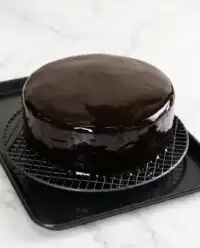
Chocolate Mirror Glaze Cake
- Total Time: 1 hour 20 mins
- Yield: 12 servings
Description
Create a professional-grade dessert with this stunning Chocolate Mirror Glaze Cake. This recipe guides you through the precise temperature control needed to achieve a flawless, obsidian-like finish that perfectly encapsulates a rich, structured cake.
Ingredients
- Dutch-processed cocoa powder
- Powdered gelatine
- Cold water
- Pure whipping cream
- Caster sugar
- Dark chocolate ganache (prepared)
- Chocolate cake layers (prepared)
Instructions
- Level and frost. Ensure your cake layers are level and chilled, then coat thoroughly with ganache and refrigerate for one hour to create a stable foundation.
- Bloom the gelatine. Sprinkle gelatine over cold water in a bowl, stir gently, and let it rest for five minutes until fully hydrated.
- Create cocoa paste. Combine cocoa powder and water in a heavy-bottomed saucepan, stirring until a smooth, uniform paste forms.
- Temper the mixture. Gradually fold in the cream and sugar to the cocoa paste using a spatula, ensuring the mixture remains smooth without introducing air bubbles.
- Heat to boil. Warm the mixture over medium-high heat until the first large bubbles appear, then remove from heat immediately to prevent scorching.
- Dissolve and strain. Stir the gelatine mass into the warm cocoa base until dissolved, then pass the liquid through a fine-mesh strainer into a shallow bowl.
- Pour the glaze. Pour the glaze, cooled exactly to 30°C (86°F), over your chilled cake in a steady, expanding spiral motion.
- Set and serve. Allow the glaze to set for ten minutes, then carefully transfer the cake to a serving platter using offset spatulas.
Notes
- Use a digital thermometer to hit the exact 30C pour temperature to avoid the glaze sliding off or clumping.
- Avoid using a whisk throughout the process to prevent the creation of air bubbles that can ruin the reflective surface.
- Keep a culinary torch or toothpicks handy to quickly remove any surface bubbles before the gelatine sets.
- Warm your knife in hot water and wipe dry between every slice to maintain the integrity of the glossy finish.
- Prep Time: 60 mins
- Cook Time: 20 mins
- Category: Dessert
- Method: Pouring
- Cuisine: French
The Mise en Place
To construct a successful mirror coating, every component must be weighed with laboratory precision before the heat is applied. The interaction between the dry solids of the cocoa and the water-binding capacity of the gelatine forms the very foundation of this recipe. Preparing your workspace in advance guarantees that you will not rush when temperature thresholds are reached.
- Dutch-Processed Cocoa Powder: This cocoa provides the deep, nearly black hue and intense flavor profile necessary for a striking reflection. Sifting it twice removes tiny air pockets that could otherwise weaken the final surface structure of your cake.
- Powdered Gelatine: Acting as the structural framework, this setting agent allows the warm glaze to cling to the cold sides of the cake without slipping. It creates the delicate, jelly-like elasticity that holds its shape when sliced.
- Pure Whipping Cream: High-quality cream adds the required butterfat content to keep the coating supple and rich. Avoid low-fat alternatives, as they lack the density needed to prevent the glaze from running off the cake.
- Caster Sugar: The small crystal size of superfine sugar guarantees rapid dissolution during the initial heating stage. Undissolved sugar granules will ruin the surface, showing up as tiny bumps under the light.
- Dark Chocolate Ganache: This rich cream layer acts as a protective barrier, evening out any minor craters on your cake surface. A flawless glaze requires an equally flat undercoat, which only a stable chocolate cream can provide.
| Ingredient | Why It Matters |
|---|---|
| Dutch-Processed Cocoa | Yields a rich dark hue and deep chocolate flavor. |
| Powdered Gelatine | Offers structural suspension for a thin, stable setting. |
| Pure Whipping Cream | Provides critical milk solids and fats for viscosity. |
| Superfine Sugar | Dissolves rapidly to prevent granular texture on the surface. |
| Chocolate Cake Layers | Establishes a sturdy, flat foundation that resists moisture. |
The Method, Step by Step
Step 1: Prep the Cake and Ganache Foundation
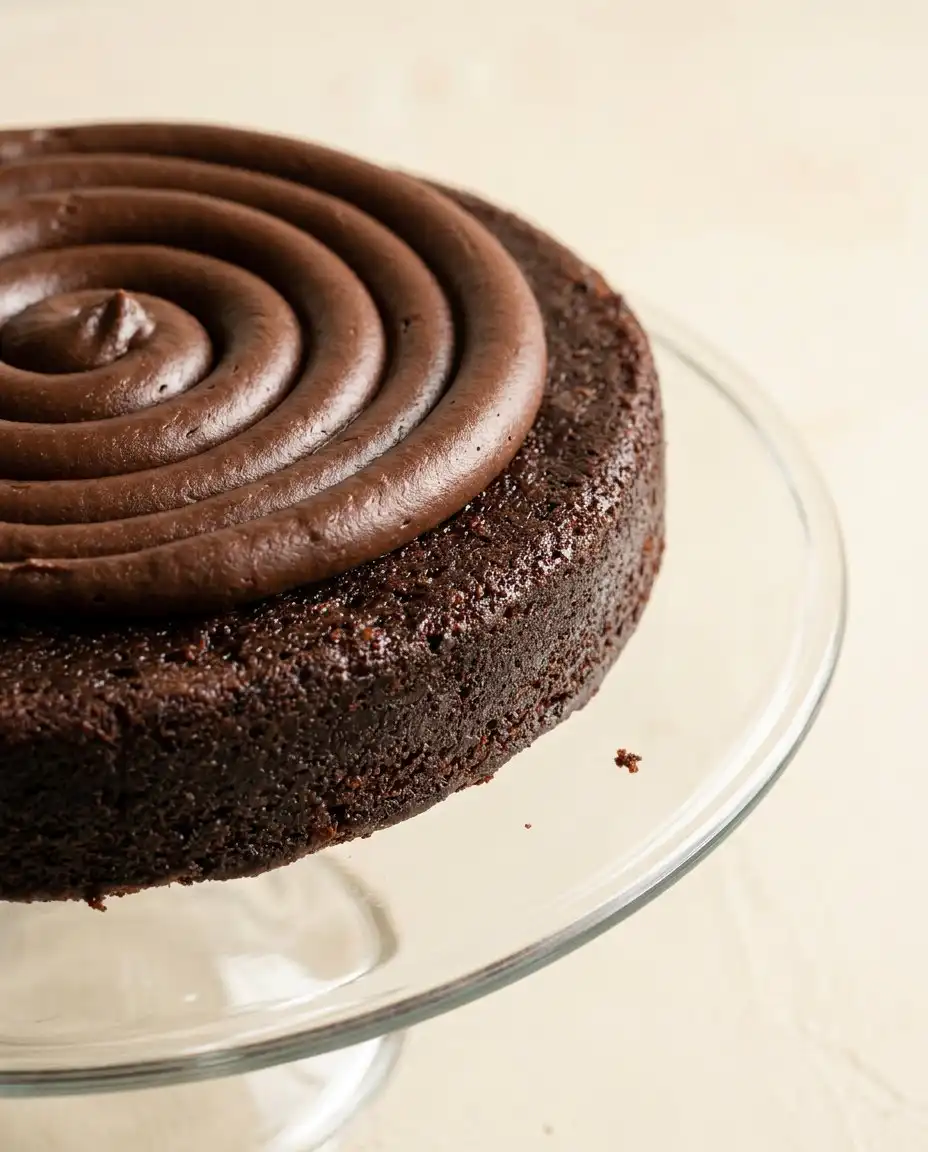
Before starting the glaze, you must confirm your cake layers are completely level and chilled. Coat the exterior with your prepared dark chocolate ganache, scraping the sides with a metal bench scraper to achieve a flat surface. Any indentation or crest on the ganache will show clearly through the thin glaze, so take your time to smooth it completely. Place the frosted assembly in the refrigerator for at least one hour to set the outer shell.
Step 2: Bloom the Gelatine
Measure your cold water into a small bowl and sprinkle the gelatine powder evenly over the liquid surface. Stir gently with a small spoon to make certain every grain is thoroughly moistened. Allow the mixture to rest undisturbed for five minutes until it absorbs the liquid. You will see it transform into a firm, rubbery mass, which confirms the proteins have hydrated properly.
Step 3: Combine Cocoa and Water
Place your sifted Dutch-processed cocoa powder and water into a heavy-bottomed saucepan. Stir them together using a silicone spatula until they form a thick, lump-free paste. By mixing these two components first, you prevent dry pockets of cocoa from floating to the top later in the process. The paste should appear dark, uniform, and slightly matte.
Step 4: Temper with Cream and Sugar
Pour a small splash of the whipping cream into your cocoa paste to loosen its structure. Gently fold in the remaining cream and superfine sugar, working the spatula in wide, slow circles. Avoid using a whisk, as rapid motion introduces air bubbles that are incredibly difficult to remove later. The mixture should feel smooth and look like a dense chocolate syrup.
Step 5: Bring to a Gentle Boil
Place the saucepan over medium-high heat and watch it closely as the temperature rises. The moment you observe the first large bubbles breaking the surface, immediately slide the pan off the heat source. Do not let it boil vigorously, as high heat can scorch the dairy and alter the viscosity. The liquid will look exceptionally shiny and run thin.
Step 6: Dissolve the Gelatine and Strain
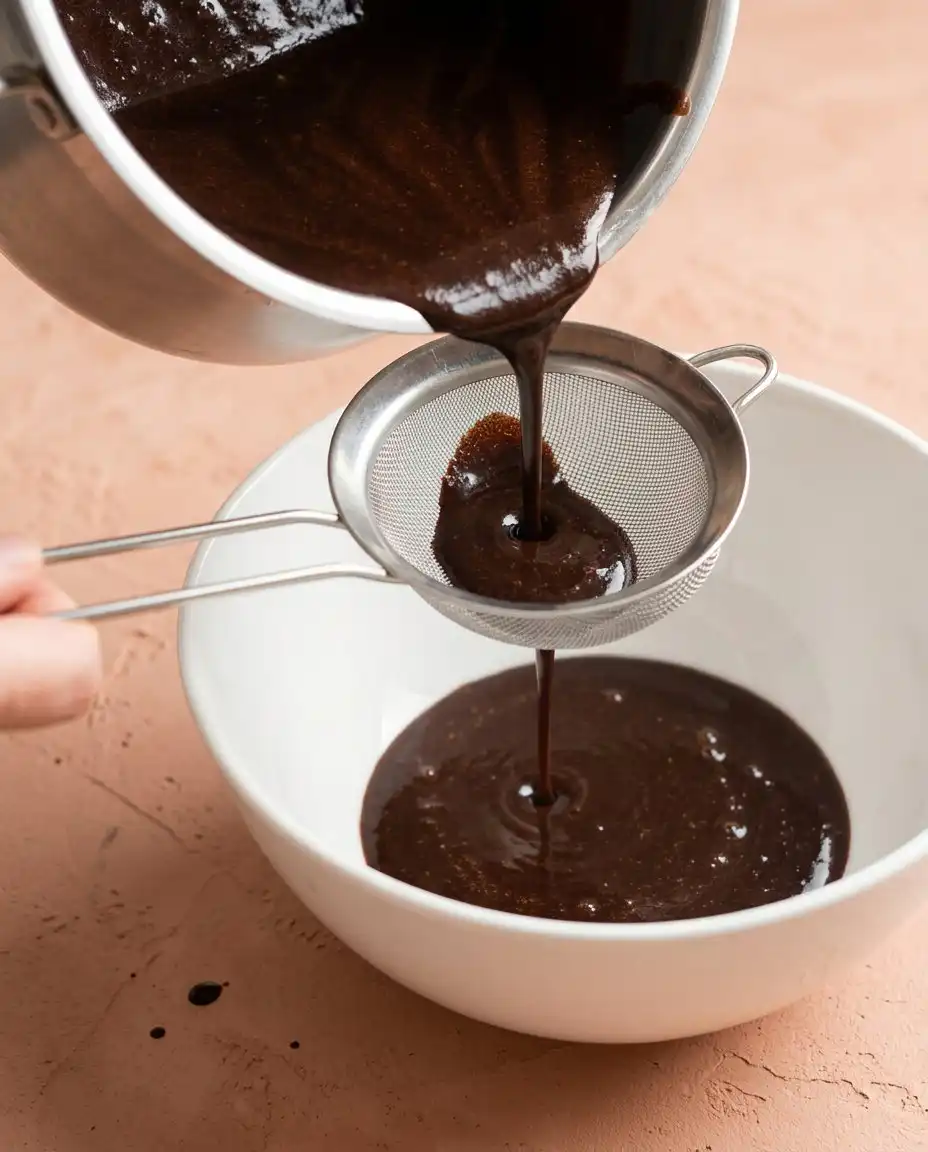
Drop the solidified gelatine mass into the hot chocolate base. Stir with a slow, continuous motion until the gelatine completely dissolves into the warm liquid. Pour the warm glaze through a fine-mesh strainer into a shallow bowl, holding the strainer as close to the bowl’s bottom as possible. This minimal drop distance prevents air from trapping inside the glossy syrup.
Step 7: Pouring Your Chocolate Mirror Glaze Cake to Perfection
Retrieve your well-chilled cake from the refrigerator and position it securely on a wire rack set over a clean baking sheet. Verify the glaze has cooled to exactly 30°C or 86°F, which is the precise temperature for a flawless flow. Begin pouring in the center of the cake, moving outward in a steady, expanding spiral. Watch the glossy chocolate drape down the sides like a dark curtain, coating every inch without hesitation. This is the definitive step of the Chocolate Mirror Glaze Cake preparation, requiring quiet focus.
Step 8: Set and Transfer
Let the glazed cake rest on the rack for ten minutes to allow the gelatine to set into its characteristic shiny film. Slip two offset spatulas carefully under the base of the cake, lifting it with a swift, confident motion. Slide the cake onto your presentation platter, using a clean butter knife to release the spatulas. The reflection on the surface should remain bright and undisturbed.
Technical Notes
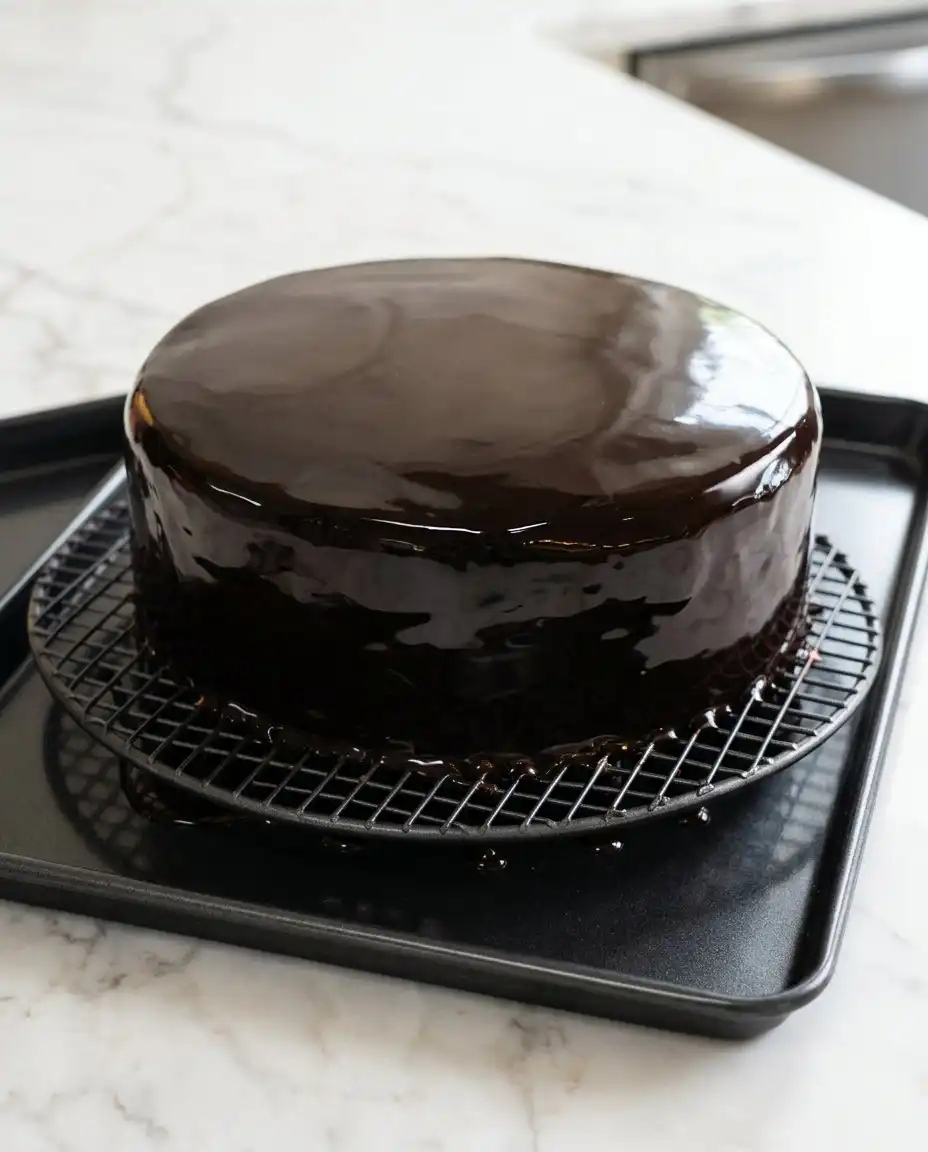
The temperature of your glaze is the absolute key to success. If your glaze is too warm, it will slide off the cake, leaving a translucent layer. If it is too cold, it will set too quickly, creating unsightly clumps and ripples. Use an accurate digital thermometer to confirm it has reached exactly 30°C (86°F) before you begin pouring.
To create an incredibly smooth undercoat, you must master the application of the frosting. A well-constructed chocolate ganache cake serves as the best foundation because ganache sets firmer than buttercream. This firm surface prevents the warm glaze from melting the frosting underneath, preserving the clean lines of your work.
Air bubbles are the primary enemy of a reflective finish. If bubbles appear on the surface after straining, do not panic. You may pass a chef’s culinary blowtorch quickly over the poured glaze on the cake, or gently pop them with a clean toothpick before the gelatine begins to set.
If your glaze runs too thin and exposes the undercoat, your temperature was likely too high when you poured. To fix this, scrape the run-off glaze from the clean sheet pan, reheat it gently to melt the gelatine, cool it back to the exact target temperature, and perform a second pour over the affected areas.
Avoid the temptation to touch the glazed cake once the pouring is complete. Even a light touch from a spatula will leave a permanent matte mark on the glossy coat. Let the physical properties of the gelatine and gravity do their work without interference.
For a visual guide on these advanced pouring methods, refer to this detailed mirror glaze technique breakdown. Studying the movement of the pour before starting will build the confidence required for a single, unbroken motion.
Frequently Asked Questions
What is mirror glaze made of?
Our classic French recipe is made from cocoa powder, water, pure whipping cream, sugar, and gelatine. Unlike many modern American versions, it does not use condensed milk, which can dull the surface over time. This traditional combination ensures a thin, elegant coating with a highly reflective finish.
Does mirror glaze have to set in the freezer?
No, the glazed cake does not require freezing to set. However, the chocolate cake underneath must be thoroughly chilled in the refrigerator before you pour the glaze. This temperature difference causes the warm gelatine to set instantly upon contact, securing the glaze in place when finishing a Chocolate Mirror Glaze Cake.
How long does it take for a mirror glaze to set?
The glaze will begin to set within five to ten minutes of being poured over the cold cake. It achieves its final stable structure after about two hours of refrigeration. Once set, the surface remains soft and delicate, yet stable enough to cut clean slices.
Why is my mirror glaze not shiny?
A lack of shine is usually caused by using incorrect sugar or overheating the glaze. Using regular granulated sugar that has not fully dissolved can leave micro-crystals that disrupt the light. Always use superfine sugar and verify that the mixture does not boil excessively during preparation.
What is the ideal temperature for pouring mirror glaze?
The ideal temperature for pouring is precisely 30°C or 86°F. At this temperature, the glaze has the perfect viscosity to flow smoothly over the edges without running off too quickly. Pouring it even a few degrees warmer will result in a coating that is too thin.
Why is my glaze sliding off the cake?
This issue occurs if your glaze was poured when it was too warm, or if the cake surface was not cold enough. The coldness of the cake is what triggers the gelatine to set as it flows. Make certain both your glaze temperature and cake temperature are exactly as instructed to avoid problems with a Chocolate Mirror Glaze Cake.
Can I use corn syrup instead of glucose syrup?
While some recipes call for glucose or corn syrup, our traditional cocoa-based glaze relies entirely on sugar and cream for its sweetness and texture. This eliminates the need for thick corn syrups, which can make the glaze gummy. Sticking to sugar and gelatine yields a superior mouthfeel.
Thoughtful Alternatives
The Mocha Infusion: For those who appreciate a deeper roasted profile, you can substitute a portion of the water in the glaze recipe with freshly brewed espresso. The coffee notes complement the Dutch-processed cocoa, lending a sophisticated bitterness. This variation pairs beautifully when coating a rich chocolate truffle cake for an elegant adult dessert.
The Citrus Contrast: You may introduce subtle complexity by adding the finely grated zest of one organic orange to the cream as it warms. Strain the cream carefully before combining it with the cocoa paste to keep the glaze texture perfectly smooth. The faint aroma of citrus cuts through the rich chocolate without altering the physical behavior of the gelatine.
The Golden Embellishment: While the glaze itself should remain pristine, you can apply delicate flakes of edible gold leaf or a light dusting of gold luster powder to the set surface. Use fine tweezers to place the gold leaf near the edges, creating a striking contrast against the dark mirror finish. This classic French presentation adds an air of quiet luxury without complicating the core technique.
Presentation and Service
Serving a masterpiece of this caliber requires tools that match the precision of its assembly. To maintain the clean, reflective edges of each slice, you must prepare your cutting utensil with care. Fill a tall container with hot water, dip your chef’s knife inside to warm the metal, and wipe it completely dry before making a cut. Clean the blade thoroughly and repeat this warming process for every single slice to prevent dragging the glaze.
This rich dessert pairs beautifully with accompaniments that offer a bright contrast to the deep cocoa flavors. Consider serving each slice alongside a spoonful of tart raspberry coulis or a small quenelle of lightly sweetened crème fraîche. For an even more indulgent experience, you might present it as part of a grand chocolate tasting menu alongside our delicate chocolate mousse cake.
The visual impact of the cross-section is the ultimate reward of your technical discipline. The clean transition from the dark, reflective glaze to the pale ganache and moist cake layers demonstrates master-level execution. Present the cake on a simple, white porcelain platter to allow the deep obsidian reflection to take center stage.
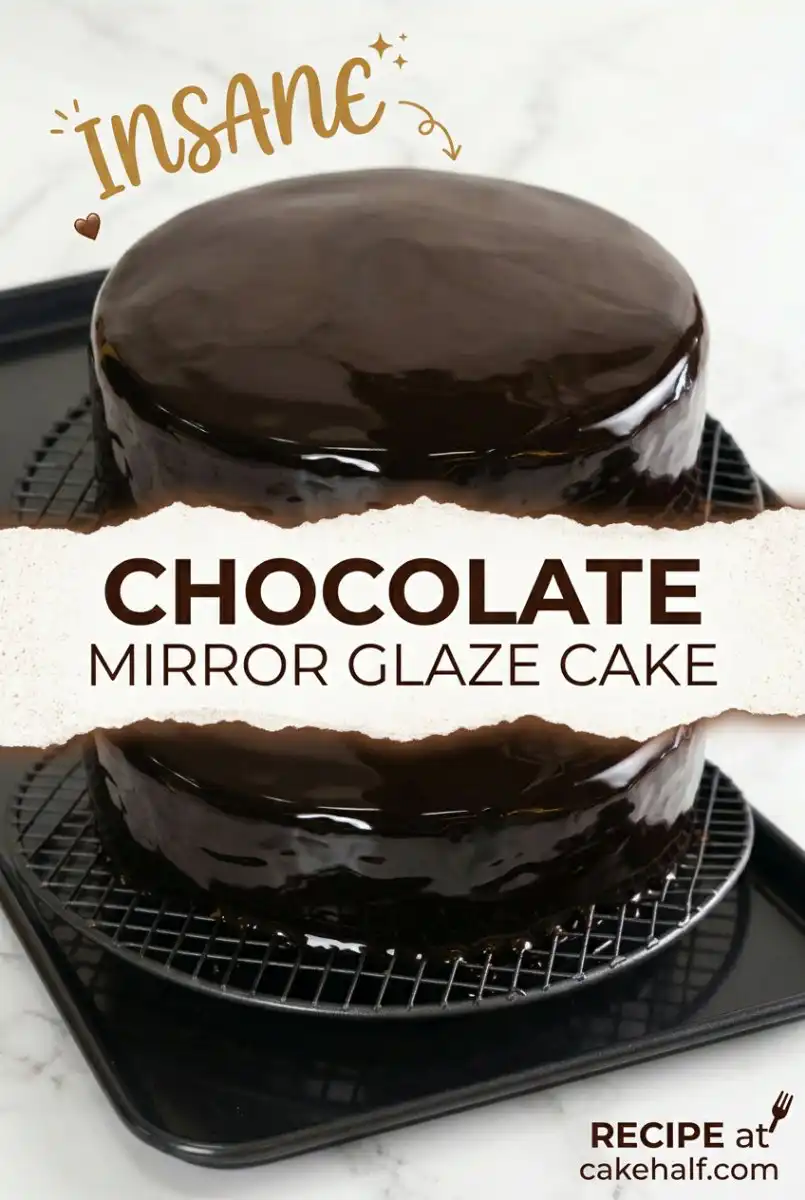
The Result of Your Care
Mastering the mirror coating is a milestone in any home baker’s journey, marking the transition from simple baking to refined pastry art. By respecting the strict rules of temperature and hydration, you have created a dessert that commands attention. Every step, from the initial bloom of the gelatine to the final sweep of the palette knife, requires your full presence.
If you enjoyed working through this meticulous process, you may want to challenge your skills further with our structured guide to the triple chocolate layer cake. Each recipe on our site is designed to build your confidence and refine your technical abilities at the bench. There is immense joy in repeating these small disciplines to achieve flawless results time after time as you perfect your skills.
We invite you to share your beautiful creations with our baking community. Let us know how your reflective surface turned out by leaving a comment below. You can also connect with us and share photographs of your finished Chocolate Mirror Glaze Cake on our Pinterest, Facebook, and TikTok channels.